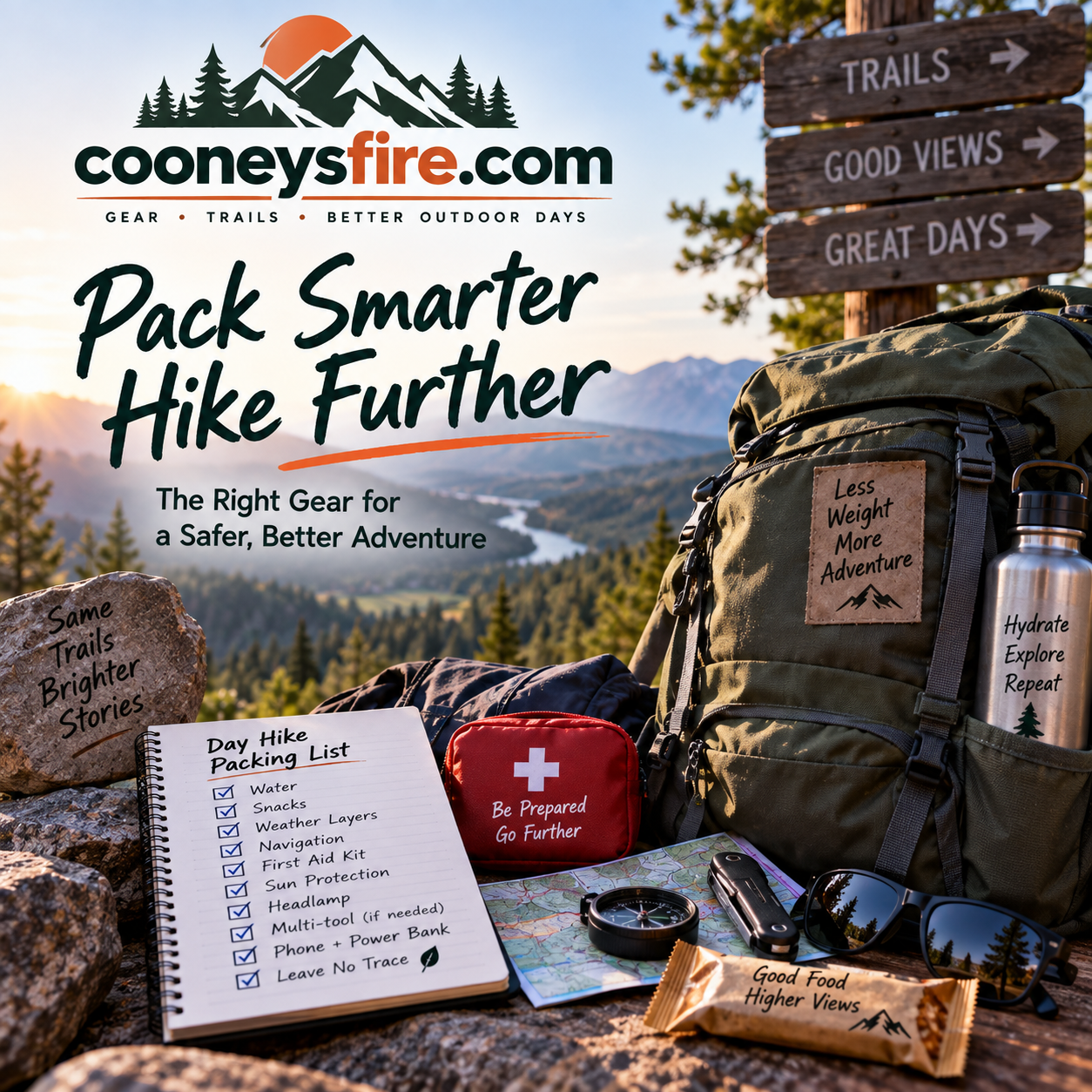
The hike is supposed to take four hours.
Your backpack looks prepared for four days.
Three shirts.
Huge towel.
Two power banks.
Enough snacks for a small family.
A giant water bottle.
Random gear you bought six months ago and have never used.
Then you start walking.
Twenty minutes later:
“Why is this bag so heavy?”
Packing for the outdoors creates an interesting problem.
You want to be prepared.
But carrying everything you might possibly need can make a simple hike unnecessarily exhausting.
Learning what to pack for a day hike is therefore not about bringing the fewest items possible.
It is about carrying the things that actually help you stay comfortable, prepared, and safe.
Start With the Hike, Not the Backpack
There is no universal packing list for every trail.
A two-hour walk through a popular park is different from an eight-hour mountain hike.
Before packing, check:
- trail distance
- elevation gain
- expected duration
- terrain
- weather
- water availability
- daylight hours
- trail conditions
- remoteness
Your backpack should match the trip.
Not someone else’s Instagram packing list.
Check the Weather Before Leaving
Blue sky outside your window does not necessarily describe conditions several hours later—or at higher elevation.
Check the forecast for the actual hiking area.
Pay attention to:
temperature,
rain,
wind,
and significant weather changes.
Then pack accordingly.
Water Comes Before Fancy Gear
You can own:
expensive trekking poles,
a premium backpack,
a GPS watch,
and beautiful hiking shoes.
None of those replace water.
Bring an appropriate amount for:
the weather,
distance,
difficulty,
and your individual needs.
Hot conditions and strenuous terrain can increase how much you need.
Do Not Assume You Can Refill Anywhere
A stream beside the trail may look crystal clear.
That does not automatically make it safe to drink untreated.
If your route depends on natural water sources, research them beforehand and use an appropriate treatment or filtration method.
For many short day hikes, carrying enough water from the start may be simpler.
Bring More Food Than the Exact Minimum
You probably do not need a three-course lunch for a short hike.
But having a little extra food can be useful if the hike takes longer than expected.
Good trail food is usually:
easy to carry,
easy to eat,
and relatively energy-dense.
Depending on your preferences, that might include:
nuts,
sandwiches,
fruit,
energy bars,
or other portable foods.
Do Not Pack the Entire Kitchen
There is a difference between:
“I should have enough food.”
and:
“What if I suddenly need six bananas?”
For a normal day hike, choose food based on realistic needs.
Your shoulders will appreciate the restraint.
Wear the Right Shoes for the Terrain
Not every hike requires massive hiking boots.
But footwear should make sense for:
distance,
surface,
weather,
and trail difficulty.
A maintained, relatively flat trail may have different footwear requirements from rocky, wet, or technical terrain.
Most importantly:
do not choose your longest hike as the first day wearing brand-new footwear.
Blisters Can Ruin an Otherwise Easy Hike
A tiny hot spot on your heel at kilometer two can become a miserable problem later.
Properly fitting footwear and suitable socks matter.
Some hikers also carry simple blister-care supplies.
If you notice irritation developing, dealing with it early is usually better than pretending it does not exist.
Dress for Movement, Not the Parking Lot
You step out of the car.
It feels cold.
So you wear everything.
Ten minutes uphill later?
Too hot.
Layering makes temperature management easier.
Depending on conditions, you may use:
a base layer,
insulating layer,
and weather-resistant outer layer.
You can add or remove clothing as conditions change.
Avoid Waiting Until You Are Sweating Heavily
If you know a steep climb is coming, adjust layers early.
Getting extremely sweaty can become uncomfortable when you stop moving or temperatures drop.
Learning to regulate clothing during the hike is part of outdoor comfort.
A Lightweight Rain Layer Can Be Worth the Space
Weather changes.
Forecasts are imperfect.
A compact rain shell can be useful when rain or wind appears unexpectedly.
Again, match your clothing to the actual environment.
A short urban nature walk and a remote mountain route require different levels of preparation.
Sun Protection Is Easy to Forget
Cloudy does not always mean zero sun exposure.
Depending on conditions and location, consider:
sunscreen,
sunglasses,
a hat,
and protective clothing.
This becomes particularly important on exposed trails where shade is limited.
Carry Basic Navigation
Your phone is an excellent navigation tool.
Until:
the battery dies,
there is no signal,
or you accidentally leave the trail.
Download offline maps when appropriate.
For more remote routes, additional navigation tools and the knowledge to use them may be necessary.
Technology is useful.
Preparation is better.
Screenshot Important Information
Before leaving reliable service, save useful information such as:
trail map,
parking location,
route details,
and emergency information.
Do not assume every page will load when you need it.
Bring a Power Bank When It Makes Sense
For longer hikes, a small power bank can be useful.
Especially if your phone is handling:
navigation,
photos,
communication,
and emergency access.
But you probably do not need three giant batteries for a two-hour walk.
Again:
pack for the actual trip.
Put Your Phone in Low-Power Mode
Battery conservation is easy.
Reduce unnecessary screen use.
Lower brightness where practical.
Close apps you do not need.
Use offline navigation.
Your phone does not need to spend the entire hike searching desperately for a weak signal.
Carry a Small First-Aid Kit
You do not need to transform your backpack into an ambulance.
For ordinary hiking, a compact kit may cover common minor problems such as:
small cuts,
blisters,
scrapes,
and other basic needs.
The contents should reflect your trip, medical needs, environment, and level of training.
And remember:
carrying first-aid equipment is useful only if you understand how to use it appropriately.
Personal Medication Is Not Optional Gear
If you require medication, make it part of your essential packing routine.
Do not treat it like an optional accessory.
For certain medical conditions or remote trips, additional planning may be appropriate.
A Small Light Can Save a Bad Situation
“It is a daytime hike.”
Correct.
But hikes sometimes take longer than expected.
Wrong turn.
Long break.
Injury.
Slower pace.
Suddenly sunset is much closer than planned.
A compact headlamp or flashlight takes relatively little space and can become extremely useful.
Why a Headlamp?
Because your hands remain free.
That matters when:
walking,
checking a map,
handling equipment,
or helping someone.
Check the battery before leaving.
A headlamp with dead batteries is mostly an unusual forehead decoration.
Carry Some Form of Emergency Signaling
Depending on where you hike, a whistle can be a simple addition.
Sound can travel farther than repeatedly shouting.
Remote hiking may require more advanced communication or emergency equipment.
The farther you move from reliable help, the more seriously communication planning matters.
Tell Someone Where You Are Going
This costs nothing.
Tell a trusted person:
where you are hiking,
your planned route,
when you expect to finish,
and when they should become concerned if you do not check in.
For solo hikers, this habit becomes especially valuable.
Do Not Change the Route Without Telling Anyone
Your original plan says Trail A.
At the junction:
“Trail B looks interesting.”
Three hours later, the person who knows your itinerary is looking for you on Trail A.
If you significantly change plans and communication is available, update your contact.
Bring Identification
A simple form of identification is easy to carry.
You may also want relevant emergency contact information accessible where appropriate.
Small preparation can simplify difficult situations.
Trekking Poles Are Optional, Not Mandatory
Some hikers love them.
Others rarely use them.
Poles may help with:
balance,
certain climbs,
descents,
and uneven terrain.
But whether they are worth carrying depends on:
terrain,
personal preference,
and physical needs.
Do not buy gear simply because every hiking video seems to feature it.
A Knife Is Not Automatically an Essential
Outdoor packing lists sometimes become survival fantasies.
You are hiking a popular trail for three hours.
You probably do not need equipment designed for building a wilderness settlement.
Bring tools that match realistic situations.
Preparation should be practical rather than theatrical.
The Same Applies to Giant Survival Kits
Could something go wrong?
Yes.
Should you prepare?
Absolutely.
But preparation should scale with risk.
A remote backcountry trip deserves more extensive planning than a short, well-trafficked trail close to town.
Understand the environment instead of copying a generic list.
Leave Space in the Backpack
A completely stuffed backpack creates problems.
Removing one item means unpacking five others.
Leave some room.
It makes it easier to:
store removed layers,
organize gear,
and access essentials.
Pack Frequently Used Items Where You Can Reach Them
Do not bury your water underneath:
jacket,
lunch,
first-aid kit,
and everything else.
Keep frequently needed items accessible.
For example:
water,
snacks,
sunscreen,
map,
and rain protection.
Good packing reduces unnecessary stops.
Heavy Items Should Not Swing Around
A badly packed backpack can feel worse than a slightly heavier but well-organized one.
Keep dense items secure and reasonably close to your body where the pack design allows.
Avoid having heavy objects bouncing at the outer edge of the backpack.
Use the Backpack Straps Properly
A backpack hanging loosely from your shoulders may become uncomfortable.
If your pack has:
hip belt,
sternum strap,
or load-adjustment features,
learn how they work.
A properly fitted pack distributes weight more effectively.
Do a Ten-Minute Test Walk
Pack everything.
Put the backpack on.
Walk around.
Use stairs.
Then ask:
What is unnecessarily heavy?
What is uncomfortable?
What rattles?
What is difficult to reach?
It is much easier to reorganize at home than halfway up a trail.
Remove the “Just in Case” Duplicates
One warm layer?
Reasonable.
Three?
Maybe not.
One power bank?
Useful.
Three?
Probably unnecessary for most day hikes.
Some redundancy is important for critical safety items on certain trips.
But ordinary comfort items do not all need backups.
Do Not Forget Trash
Bring a small bag or container for your own waste.
Snack wrappers do not become part of nature because they have mountains printed on the packaging.
Pack out what you bring in.
Follow local regulations and Leave No Trace principles.
Respect Wildlife
Food should not be deliberately left behind for animals.
Feeding wildlife can change animal behavior and create problems for both animals and visitors.
Store and handle food according to local wildlife guidance.
Different areas may have specific requirements.
Your Packing List Should Change With the Season
Summer hike:
sun,
heat,
water.
Cold-season hike:
temperature,
shorter daylight,
snow,
ice,
and rapidly changing conditions.
The same trail can become a very different activity depending on the season.
Never assume previous experience automatically describes today’s conditions.
A Simple Day-Hike Packing Checklist
For many ordinary hikes, your core list might begin with:
Water
Enough for the route and conditions.
Food
Meals or snacks appropriate for the duration, plus a reasonable margin.
Weather-appropriate layers
Including rain or wind protection when conditions warrant it.
Navigation
Offline phone map and additional tools where necessary.
Sun protection
Sunscreen, hat, sunglasses, or appropriate clothing.
Basic first aid
Matched to your needs and trip.
Personal medication
Anything you genuinely require.
Light
A small headlamp or flashlight.
Communication
Charged phone and appropriate emergency communication for the area.
Identification
Simple and easy.
Then add trip-specific equipment.
Not random equipment.
Before Leaving the Trailhead, Ask Five Questions
1. Do I have enough water?
2. Do I know where I am going?
3. Does someone know my plan?
4. Am I prepared for today’s weather?
5. Can I safely handle being out longer than expected?
If the answer to one is no, solve it before starting.
The mountain is not going anywhere.
FAQ
How heavy should a day-hiking backpack be?
There is no universal ideal weight. It depends on your body, route, weather, water needs, equipment, and trip duration. The goal is to carry necessary safety and comfort items without unnecessary weight.
How much water should I bring hiking?
Water needs vary considerably with temperature, duration, intensity, elevation, individual needs, and access to safe refill sources. Plan for the specific hike rather than relying on one universal amount.
Do I need hiking boots for every trail?
No. Footwear should match the terrain, conditions, distance, and your needs. Some maintained trails may be suitable for hiking shoes or appropriate trail footwear.
Should I bring a first-aid kit on a short hike?
A compact basic kit can be useful even on shorter hikes. Remote or difficult trips may require more extensive preparation.
Is my phone enough for hiking navigation?
Phones are extremely useful, especially with offline maps, but batteries can fail and coverage may disappear. More remote routes may justify backup navigation and additional emergency communication.
What is the most commonly overpacked hiking gear?
Extra clothing, excessive food, duplicate electronics, oversized equipment, and “just in case” gadgets can quickly add unnecessary weight.
Conclusion
A good hiking backpack is not the one carrying the most gear.
And it is definitely not the one that looks most impressive beside the trail sign.
It is the one that matches:
your route, the weather, the environment, and realistic risks.
Bring the essentials.
Prepare for reasonable problems.
Leave unnecessary duplicates at home.
And remember:
packing lighter does not mean ignoring safety.
It means understanding the difference between something you genuinely need and something you packed because a 40-minute YouTube video convinced you every day hike is an expedition.
Your shoulders will notice the difference.