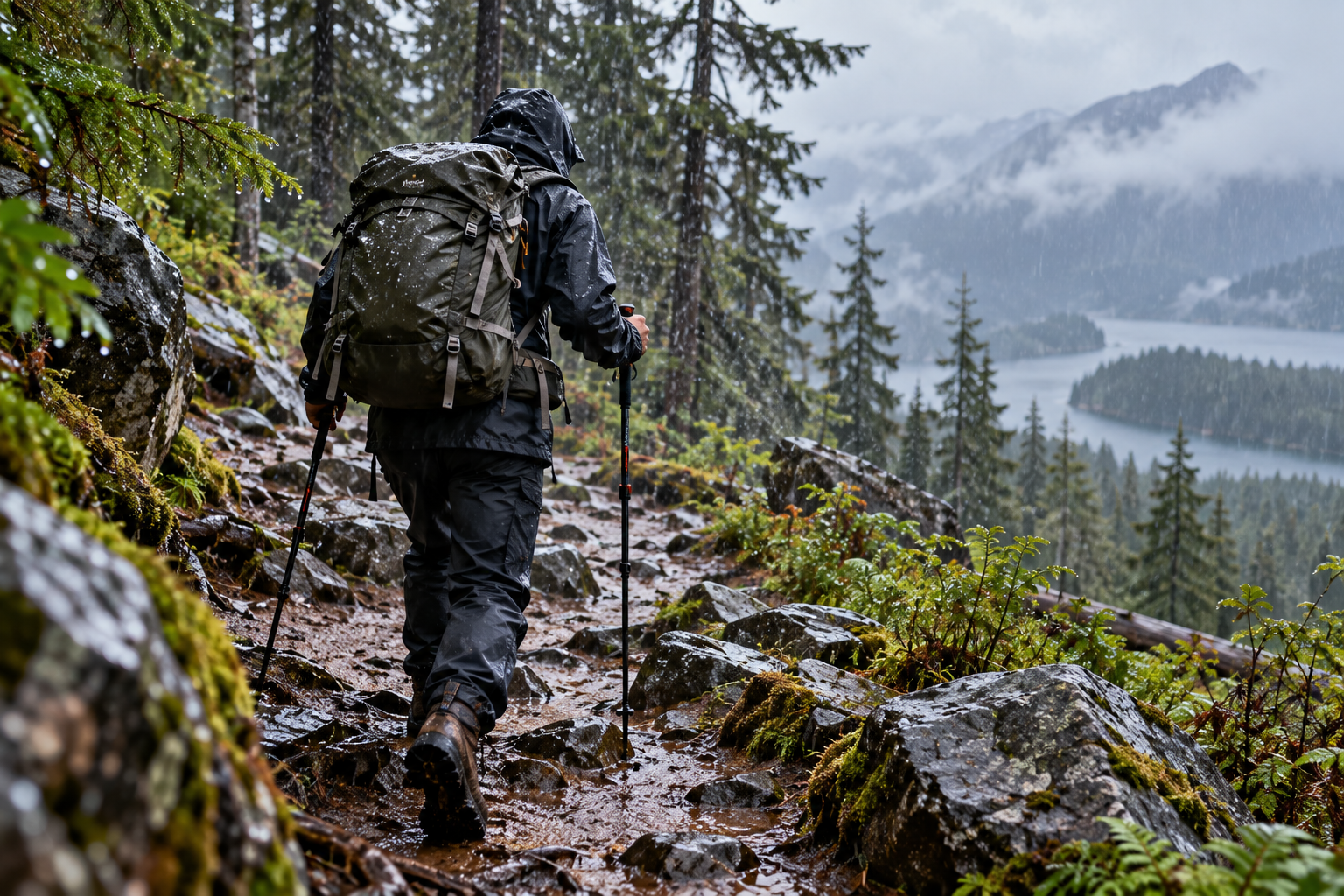
The trail is familiar.
You have walked it before without thinking much about every step. The climb is manageable, the descent is straightforward, and the small creek halfway through barely deserves attention.
Then it rains.
Suddenly the same trail feels different.
Roots that normally provide easy footholds become slick. Rocks that looked harmless demand careful foot placement. Mud slows your pace. Your jacket keeps rain out but somehow you still feel damp underneath it. The creek that was ankle-deep last time is moving faster than you remember.
Nothing about the map changed.
But almost everything about the hike did.
That is what makes hiking in the rain different from simply doing a normal hike while carrying an umbrella. Rain changes traction, visibility, body temperature, water levels, gear performance, and sometimes the route itself.
The goal is not to prove that bad weather cannot stop you.
The goal is to understand when a wet hike is manageable, what needs to change, and when continuing is no longer worth the additional risk.
Hiking in the Rain Starts Before You Reach the Trail
Preparation for a wet hike begins with the forecast.
But do not stop after seeing a rain icon.
Look at what kind of weather is expected.
Light rain for several hours creates a different situation from a short thunderstorm.
Heavy rain after several already-wet days can affect trails differently from the first shower after a dry period.
Temperature matters.
Wind matters.
Visibility matters.
Thunderstorm risk matters.
The terrain matters too.
A wide forest path in light rain is not the same decision as an exposed ridge, steep rocky descent, river crossing, or narrow canyon under the same forecast.
Weather should be interpreted together with the route.
“Rain” Is Too Broad to Be a Useful Description
A forecast saying there is a chance of rain tells you surprisingly little about trail conditions.
Ask more specific questions.
How much precipitation is expected?
When will it begin?
How long could it continue?
Will temperatures fall?
Is strong wind expected?
Could thunderstorms develop?
Has the area already received substantial rain?
A light shower may simply make a trail damp.
Sustained rainfall can saturate soil, increase runoff, swell streams, reduce visibility, and make some slopes unstable.
Your decision should reflect the conditions that actually matter for that route.
Check Trail Conditions, Not Just Weather Conditions
The sky can clear while the trail remains wet.
Rain from yesterday may still matter today.
Mud persists.
Streams remain elevated.
Wooden bridges can stay slick.
Low areas may remain flooded.
Recently damaged sections may deteriorate further.
Before leaving, check available trail reports or information from the relevant park, land manager, or local authority when possible.
A sunny morning does not automatically mean yesterday’s storm has stopped affecting the route.
Wet Trails Reduce Your Margin for Error
A dry rock may provide excellent traction.
The same rock covered in water, mud, moss, or wet leaves may behave completely differently.
Roots are another common example.
On a dry trail, stepping directly onto a large exposed root may feel secure.
When wet, that smooth surface can become surprisingly slippery.
This does not mean every rainy trail is dangerous.
It means movements that were automatic in dry weather may require more attention.
When hiking in the rain, assume your normal pace may no longer be appropriate.
Slow Down Before the Difficult Section
Do not wait until you nearly fall before adjusting your pace.
Shorten your steps.
Place your feet deliberately.
Give yourself more room before steep descents.
Avoid rushing because you want to “get out of the rain.”
That impulse can create exactly the situation you are trying to avoid.
A wet hike often takes longer than the same distance in dry conditions.
Build that slower pace into your time estimate before starting.
Descents Can Become Harder Than Climbs
Climbing usually makes slippery terrain obvious because you are looking directly at what is ahead.
Descending can be less forgiving.
Gravity is already pulling you downhill.
A foot that slides unexpectedly can quickly throw your balance backward.
On muddy or rocky descents, reduce speed and look several steps ahead.
Do not commit to a foothold simply because it worked when the trail was dry last week.
The surface has changed.
Treat it like a different trail.
Trekking Poles Can Add Useful Stability
Trekking poles are not required for every wet hike, but they can provide additional contact points on slippery terrain.
They may be particularly useful during muddy descents, uneven ground, or when testing uncertain surfaces.
Poles do not make poor footing safe.
They also do not replace careful movement.
Think of them as another stability tool rather than permission to move faster.
The objective remains controlled foot placement.
Waterproof Does Not Mean You Will Stay Completely Dry
This is one of the biggest expectations to correct.
You put on a waterproof jacket.
Rain stays outside.
Then an hour later, your shirt still feels damp.
What happened?
Possibly sweat.
While hiking, your body generates heat and moisture. A waterproof-breathable shell can allow some moisture vapor to escape, but it cannot magically remove unlimited sweat under every combination of temperature, humidity, pace, and rainfall.
If you hike hard enough inside rain gear, you can become wet from the inside.
The solution is not always a “more waterproof” jacket.
Sometimes it is better moisture management.
Ventilation Is Part of Rain Protection
If your shell has ventilation features, use them when conditions allow.
Open pit zips.
Adjust the front zipper.
Modify your layers.
Reduce pace before you begin sweating heavily.
The objective is not to feel warm and cozy while climbing.
You want to avoid producing so much internal moisture that your clothing becomes soaked underneath the shell.
This can feel counterintuitive.
It is raining, so naturally you want to seal everything.
But if you trap too much heat, you may end up wet anyway.
Start Slightly Cool Instead of Overdressed
A common mistake is dressing for how cold you feel beside the car.
Then you start climbing.
Within ten minutes, your body produces much more heat.
Now you are sweating inside your layers.
Later, you stop for a break and that moisture begins cooling you.
For active hiking, clothing should account for the heat you will generate while moving.
Carry insulation for stops rather than wearing every warm layer from the beginning.
Wet-weather comfort is often about preventing unnecessary moisture, not merely blocking rain.
Avoid Cotton When Cold and Wet Conditions Matter
Cotton can hold substantial moisture and becomes a poor choice when staying warm while wet is important.
Synthetic fabrics and wool are commonly preferred for wet hiking layers because they manage moisture and retain useful insulating properties more effectively in damp conditions.
This does not mean every rainy walk requires specialized expedition clothing.
But when temperatures are cool, the route is remote, or you may be outside for several hours, clothing materials matter more.
A wet cotton shirt on a warm urban walk is inconvenient.
A wet cotton layer in cold wind far from shelter can become a much bigger problem.
Keep a Dry Layer Actually Dry
Carrying an extra warm layer is useful only if it remains dry.
Do not simply place it loose inside a backpack and assume the pack will protect it.
Many backpacks resist light moisture but are not completely waterproof in prolonged rain.
Use appropriate internal waterproof protection for items that need to stay dry.
Your spare insulation, emergency clothing, electronics, and other moisture-sensitive essentials deserve more protection than the snacks you plan to eat in twenty minutes.
A Pack Cover Is Helpful but Not Perfect
Pack covers can reduce how much rain reaches the backpack.
But water can still reach parts of the pack around straps, back panels, openings, or areas the cover does not fully protect.
For critical dry items, internal protection provides another layer of security.
A pack liner or individual waterproof dry storage can keep important equipment isolated even if the backpack itself becomes wet.
Think in layers of protection rather than assuming one barrier can never fail.
Protect Your Sleep System on Overnight Trips
A wet shirt is uncomfortable.
A soaked sleeping bag can become a much more serious problem when you are camping in cold conditions.
For overnight trips, protect your sleep system carefully.
Sleeping bag or quilt, dry sleep clothing, and other critical insulation should remain isolated from wet gear.
Do not open the dry storage unnecessarily while standing in rain.
Organize the pack so that you can access rain gear, food, navigation, or other frequently needed items without exposing everything else.
Good packing becomes much more valuable in poor weather.
Your Feet Will Probably Be a Major Part of the Day
Rain hiking discussions often focus on jackets.
Meanwhile your feet spend hours dealing with:
mud,
puddles,
wet vegetation,
stream crossings,
and moisture inside footwear.
Whether you prefer waterproof footwear or faster-draining options depends on conditions and hiking style.
There is no single answer for every environment.
What matters is understanding that wet feet change friction.
And friction can create hotspots and blisters.
Socks Matter More When Everything Is Wet
Choose socks appropriate for hiking rather than relying on thick everyday cotton socks.
Carry a spare pair when the conditions and trip length justify it.
But be strategic.
If you change into your only dry socks and immediately step back into saturated footwear, they may become wet quickly.
On an overnight trip, keeping one pair reserved for sleeping can be extremely valuable.
Dry feet at camp are not merely a luxury.
They give your skin time away from continuous moisture.
Waterproof Boots Are Not Invincible
Waterproof footwear can help in shallow puddles, wet grass, mud, and sustained rain.
But water can still enter from the top.
Once the inside is soaked, waterproof construction can also mean the footwear takes longer to dry.
Gaiters can reduce water and debris entering around the ankle in some conditions.
But again, no system makes your feet immune to prolonged wet weather.
Plan around moisture rather than assuming it can always be eliminated.
Wet Skin Needs Attention
Hours of moisture can soften skin.
Combine that with repetitive friction and you have conditions where foot problems can develop more easily.
Pay attention to hotspots early.
Do not wait until discomfort becomes a painful blister.
During longer trips, use opportunities to air your feet when practical.
Change socks if it genuinely improves the situation.
Keep camp footwear and sleeping socks dry if you carry them.
Small foot-care decisions can determine whether the second half of a hike remains enjoyable.
Mud Is More Than an Annoyance
Mud slows movement and changes traction.
Deep mud can also tempt hikers to leave the established trail and walk around it.
That can widen the trail and damage surrounding vegetation.
Where appropriate and safe, stay on the durable established route rather than creating a new path around every muddy section.
Of course, do not blindly step somewhere unsafe just to remain exactly on a line.
The larger principle is to avoid unnecessary trail widening while still making safe decisions.
Wet Leaves Can Hide the Surface
A layer of wet leaves may look harmless.
Underneath could be:
a smooth rock,
a root,
a hole,
or loose mud.
This is especially relevant on descents.
Do not assume the visible surface tells you everything about the footing beneath it.
Reduce speed when the ground is obscured.
Rain makes trail reading more important because familiar visual cues can disappear.
Wooden Structures Can Become Surprisingly Slick
Boardwalks, steps, bridges, and logs can become slippery when wet.
Wood with algae or organic buildup deserves even more caution.
Place your feet deliberately.
Use handrails where available.
Do not assume a constructed trail feature automatically provides better traction than the surrounding ground.
Wet weather changes artificial surfaces too.
Stream Crossings Deserve a New Decision
A crossing you used safely last month does not automatically remain safe after rain.
Water depth can increase.
Current speed can increase.
Water may become cloudy, hiding the bottom.
Stepping stones may disappear.
Logs may become slippery.
The consequences of falling can change dramatically.
Approach every swollen stream as a new problem.
Past experience with the location is useful, but it is not permission to cross regardless of current conditions.
Turning Around at a Stream Is a Successful Decision
People often feel committed after hiking several miles to reach a crossing.
You have already invested time.
The destination may be close.
It becomes tempting to think:
“We came all this way.”
That is not a safety argument.
If a crossing looks substantially more dangerous than expected, turning around protects the rest of the trip.
The mountain, waterfall, viewpoint, or campsite does not care how far you already walked.
You can return another day.
Rain Upstream Can Affect You Downstream
One of the reasons water hazards deserve caution is that conditions at your location do not tell the whole story.
Water can rise because of rainfall elsewhere in the drainage.
This is particularly important in areas susceptible to flash flooding.
A canyon or wash can become dangerous even if the rain is not falling directly overhead.
Know the type of terrain you are entering.
For routes where flash flooding is a recognized hazard, check appropriate forecasts and warnings before committing.
Thunder Changes the Decision Completely
Ordinary rain and thunderstorms should not be treated as the same thing.
If lightning becomes part of the weather, exposure matters.
Open ridges, summits, and other exposed terrain can become particularly poor places to remain.
This is why checking the timing of storms before starting matters.
If thunderstorms are expected later in the day, an earlier start may reduce exposure on some routes—but only if the overall forecast and route remain appropriate.
Do not treat a thunderstorm as “just heavier rain.”
Visibility Can Disappear Faster Than Expected
Cloud, fog, and heavy rain can obscure landmarks.
A route that is obvious on a clear day may become confusing.
Trail junctions are easier to miss.
Distant terrain used for orientation may disappear.
Phone screens become harder to operate with wet fingers.
Electronics can fail.
This connects directly with trail navigation.
Carry navigation appropriate for the route and know how to use it before conditions deteriorate.
Bad weather is a poor time to learn your navigation system for the first time.
Waterproof Your Navigation Tools
If your route depends on a paper map, protect it appropriately.
If you use a phone, consider how you will keep it dry and powered.
Download necessary offline information before leaving areas with reliable connectivity.
Do not assume mobile service will improve because the weather becomes worse.
For more remote routes, appropriate backup navigation becomes increasingly important.
Redundancy matters most when the primary system stops working.
Rain Can Make a Familiar Trail Feel Unfamiliar
This is worth repeating.
Familiarity can create overconfidence.
You remember a dry trail.
You remember where you stepped.
You remember the easy crossing.
You remember how long the descent took.
But rain changes the conditions underlying those memories.
The route may still be familiar geographically while being very different operationally.
Use previous experience as information.
Do not use it as an excuse to ignore current conditions.
Your Pace Should Change With the Surface
If your normal pace is three miles per hour, that number is not a promise.
Wet terrain may reduce it considerably.
Mud slows you.
Careful descents slow you.
Stream crossings take longer.
Putting on or removing layers takes time.
Navigation may require more attention.
Build extra time into the day.
Otherwise you may find yourself rushing late in the hike precisely when fatigue and poor footing make rushing least desirable.
Daylight Is a Resource
A rainy hike can become a night hike if your timing assumes dry-trail speed.
Carry a reliable light even when you expect to finish before sunset.
A headlamp weighs little compared with the problems created by navigating a wet trail in darkness without one.
Also consider turnaround time.
If progress is significantly slower than expected, adjust the objective.
You do not need to reach the original destination simply because it was written in the plan.
Eat and Drink Even When the Weather Feels Cool
Cool rainy conditions can reduce the sensation of thirst.
You are still moving.
You are still losing water.
You are still using energy.
Do not neglect hydration simply because you are not hiking under hot sun.
Likewise, keep food accessible enough that eating does not require unpacking your entire backpack in heavy rain.
Simple organization makes it easier to maintain energy without exposing dry gear.
Breaks Need to Be Managed Differently
During a dry hike, sitting for twenty minutes may feel pleasant.
When you are damp and temperatures are low, a long stop can make you cold quickly.
Your body is producing heat while walking.
Stop moving and that heat production decreases.
Add wet clothing and wind, and the difference can become uncomfortable fast.
For cool wet hikes, shorter breaks may work better.
If stopping longer, add insulation before you become cold.
Do Not Wait Until You Are Shivering Hard to Add Warmth
Temperature management works best when it is proactive.
If you know you are about to stop, add a layer before your body cools substantially.
If wind increases, respond.
If your pace slows because someone in the group is tired, reconsider layers.
If clothing becomes wetter than expected, reassess.
The goal is maintaining a manageable thermal state, not repeatedly becoming cold and then trying to recover.
Wet and Windy Can Be Much Harder Than Wet Alone
A mild rainy day under tree cover can feel manageable.
Add strong wind and the situation changes.
Wind increases heat loss and can make exposed sections much less comfortable.
It can also affect balance, especially on ridges.
When reading the forecast, do not isolate precipitation from wind and temperature.
Weather variables combine.
The combination often matters more than any single number.
Know the Early Signs That the Day Is Going Wrong
Not every uncomfortable moment means you must immediately turn around.
But pay attention to trends.
Are you getting progressively colder?
Is critical gear soaked?
Is visibility worsening?
Are streams rising?
Is the group moving much slower than planned?
Has someone developed a foot problem?
Are you approaching exposed terrain while thunder is developing?
A good turnaround decision is usually made before conditions become an emergency.
The Turnaround Point Does Not Need to Be Dramatic
You do not need a broken bridge or violent storm to justify ending a hike.
Sometimes the decision is simply:
“This is becoming less safe and less enjoyable than we planned for.”
That is enough.
Outdoor judgment is not measured by how much discomfort you tolerate.
Changing plans is part of hiking.
Especially when the environment changes faster than expected.
Group Decisions Should Account for the Least Comfortable Hiker
Rain affects people differently.
One person may have excellent rain gear.
Another may be getting cold.
One hiker may feel confident on wet rock.
Another may be nervous and moving slowly.
The group cannot safely operate as if everyone has the experience and equipment of the strongest member.
Check in.
Ask how people actually feel.
A group trip succeeds when everyone gets back safely, not when the fastest person reaches the objective.
Keep Essential Gear Accessible
A rain jacket buried beneath everything else is poorly packed for a wet forecast.
The same applies to:
gloves,
navigation,
food,
headlamp,
and other items you may need quickly.
Pack based on expected use.
Things needed in rain should be accessible without exposing the entire contents of your backpack.
A few minutes of organization before leaving can prevent repeated unpacking on the trail.
Wet Gear and Dry Gear Should Have Separate Lives
Once clothing becomes soaked, do not casually stuff it beside items you worked hard to keep dry.
Use a system.
Wet items go in one area.
Dry insulation remains protected.
This becomes particularly important during overnight trips.
A wet shell can be uncomfortable tomorrow.
A wet sleeping bag can affect your ability to stay warm tonight.
Not all moisture problems have equal consequences.
Prioritize accordingly.
Camp Setup Requires a Different Sequence in Rain
On an overnight trip, think about what gets exposed first.
If possible, establish shelter before unpacking moisture-sensitive equipment.
Avoid spreading gear around camp while rain continues.
Keep the sleeping system protected until you have a reasonably dry place for it.
The exact routine depends on shelter type and conditions, but the principle remains:
create a protected space before exposing the things that must remain dry.
Tent Condensation Can Complicate the Situation
Rain outside does not mean all moisture inside the tent came through the fabric.
People breathe.
Wet clothing enters the shelter.
Humid air condenses.
Poor ventilation can make the interior feel damp even when the shelter is functioning normally.
Use ventilation appropriate for the shelter and weather.
Keep wet equipment away from dry sleeping insulation as much as practical.
Rain management continues after you stop walking.
Do Not Cook Carelessly Inside a Tent
Rain can make the interior of a tent look like the most convenient place to prepare hot food.
That convenience can introduce serious fire and carbon monoxide hazards depending on the stove and shelter.
Follow the stove manufacturer’s safety guidance and use appropriate ventilation and safe cooking locations.
Bad weather does not make normal stove hazards disappear.
Plan meals so that cooking in rain remains manageable without improvising unsafe arrangements.
Drying Gear After the Hike Is Part of the Trip
You reach the car.
The hike is finished.
Not quite.
Wet gear left packed overnight can develop odor, mildew, or material problems.
At home, unpack promptly.
Dry your tent.
Air your footwear.
Remove insoles if appropriate.
Dry trekking poles and other equipment.
Hang rain gear according to its care requirements.
The next trip begins with how you store equipment after this one.
Rain Jackets Need Maintenance Too
If water once beaded beautifully on your shell but now the outer fabric quickly becomes saturated, the durable water-repellent treatment may need maintenance.
Follow the garment manufacturer’s care instructions.
Cleaning can matter because dirt and oils can affect performance.
Some garments may require restoration or renewal of their water-repellent treatment according to product guidance.
Do not assume a jacket is permanently ruined simply because the outer fabric starts wetting out.
But also do not wait until a storm to discover its current condition.
Test Rain Gear Before You Depend on It
A local walk in moderate rain can teach you more about your system than reading another gear list.
Does the hood move with your head?
Can you operate the zippers with wet hands?
Does the jacket ventilate well enough?
Do the pants restrict movement?
Does water run directly into your footwear?
Can you access your pack without soaking everything?
Test equipment somewhere with an easy exit before relying on it on a remote route.
Expensive Gear Does Not Replace Judgment
A premium waterproof shell does not make lightning safe.
High-end boots do not make a flooded stream safe.
A satellite communicator does not make unstable terrain safe.
Good equipment expands comfort and provides useful safety margins.
It does not cancel environmental hazards.
The most valuable wet-weather skill is still the ability to recognize when conditions have moved beyond what your route, gear, experience, or group can reasonably handle.
Not Every Rainy Forecast Requires Cancellation
It is equally important not to treat rain as an automatic reason to stay home.
A light rainy day on an appropriate route can be enjoyable.
Trails may be quieter.
Forests can look completely different.
Waterfalls may become more active.
Cloud and mist can create an atmosphere you would never experience on a clear afternoon.
The key is matching the hike to the weather.
Choose lower-consequence terrain.
Keep an easy turnaround option.
Shorten the route if necessary.
Rain can change the adventure without ruining it.
Choose a Rain-Day Route Deliberately
Instead of forcing the original itinerary into poor weather, consider whether another route makes more sense.
A good wet-weather alternative might have:
less exposed terrain,
fewer difficult water crossings,
simpler navigation,
shorter distance,
lower elevation,
and multiple exit options.
That is not settling for a worse hike.
It is selecting the hike that fits the day.
Outdoor plans become much more flexible when the destination is not treated as the only measure of success.
Leave More Margin Than You Think You Need
Dry conditions allow small mistakes to remain small.
You arrive thirty minutes late.
No problem.
Your socks get slightly damp.
No problem.
You take the wrong junction and backtrack.
Annoying, but manageable.
In poor weather, several small problems can combine.
You are slower.
Then darkness approaches.
Then someone becomes cold.
Then navigation gets harder.
Margin prevents these problems from stacking.
Extra time, dry insulation, navigation backup, and conservative route choices all create room for the unexpected.
A Good Rain Hike Often Feels Uneventful
You checked the weather.
Selected an appropriate trail.
Started with the right layers.
Adjusted your pace.
Kept important equipment dry.
Avoided questionable crossings.
Returned before dark.
Nothing dramatic happened.
That is success.
Outdoor preparation is not supposed to create a heroic story every time.
Often its purpose is making sure the day remains ordinary even when conditions are not.
Conclusion
Hiking in the rain is not simply the same hike with a waterproof jacket added.
Rain changes traction, visibility, water levels, body-temperature management, pace, and the way your equipment performs. A familiar route can therefore require very different decisions once the trail becomes wet.
Start by evaluating the complete weather picture rather than looking only for a rain icon. Consider rainfall intensity, wind, temperature, thunderstorms, recent weather, trail type, stream crossings, exposure, and available daylight.
On the trail, slow down before footing becomes difficult. Manage sweat as carefully as outside moisture. Protect critical dry layers inside the backpack, pay attention to your feet, and reassess water crossings based on current conditions rather than past experience.
Most importantly, keep enough flexibility to change the plan.
A rainy forecast does not automatically require canceling every hike, but reaching the original destination should never become more important than responding intelligently to the conditions in front of you.
Done well, hiking in the rain is not about proving how much bad weather you can tolerate. It is about choosing an appropriate route, managing moisture and temperature, moving carefully, and knowing when the smartest outdoor decision is simply to turn around.