
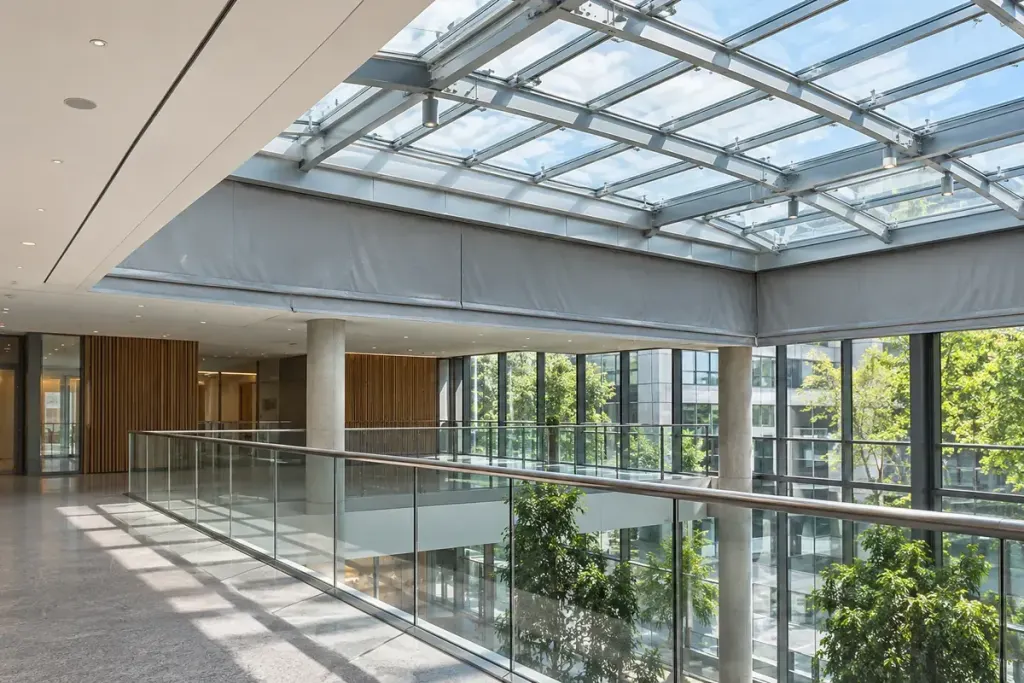
High above an atrium, a shallow barrier or descending curtain can look like an architectural detail. In some buildings it helps define a smoke reservoir: a designed region where a smoke layer is managed as part of the building’s fire strategy. It is not a storage space, and it is not proof that the occupied area will remain safe in every fire.
The Smoke Control Association’s design guidance explains how smoke movement, reservoirs, extraction and the geometry of atria or malls interact. Hot smoke can rise and spread, but its route and dilution depend on the building and fire scenario. Designing that behaviour requires specialist assessment.
The barrier is one part of a system
A smoke curtain can restrict migration or help channel smoke towards the region intended for extraction. It may work with fans, vents, replacement air, detection and controls. A curtain’s product rating alone does not establish the performance of the whole arrangement.
For example, Coopers Fire describes its draft curtain in terms of smoke-migration control for particular applications. That description is specific to a product and installation context. It should not be read as a general instruction to add a curtain wherever smoke might rise.
Ordinary alterations can become design questions
Consider an illustrative atrium refit: a tenant proposes a suspended display below the roof, while another team wants to enclose part of a balcony. Before either change is approved, the building manager needs to establish whether it affects the documented smoke-control arrangement. The relevant question is what the original design assumed about openings, obstructions and smoke routes.
Keep commissioning records, inspection arrangements and responsibilities accessible to the people managing the building. Report visible damage or obstruction through the maintenance process. Do not test, wedge, reposition or disable a curtain as an informal experiment.
During an alarm, follow the building’s emergency instructions. A visitor cannot assess a smoke reservoir’s performance by looking up at it. Understanding the feature is useful for recognising why specialist design and maintenance matter, not for deciding to delay evacuation while watching what the smoke does.