
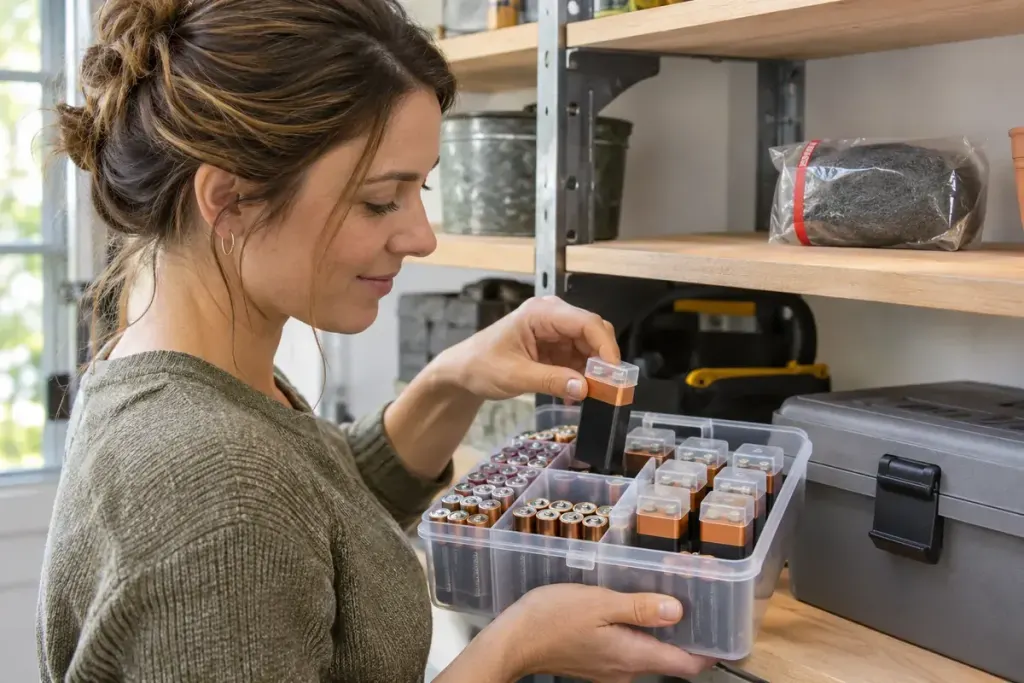
A drawer becomes a mixed storage place gradually: one spare battery, a packet of steel wool, a few keys and a screwdriver. Nothing has to be switched on for that arrangement to create a problem.
The NFPA’s guidance on 9-volt battery safety warns that metal touching the closely spaced terminals can cause a short circuit and enough heat to start a fire. It specifically advises against loose storage with items such as paper clips, keys and steel wool.
Make separation easy to maintain
Keep unused batteries in their original packaging or an appropriate holder that prevents terminal contact. Follow the maker’s storage guidance. A dedicated compartment only helps if it stays free of loose metal and does not let batteries tumble against other conductive objects.
During an ordinary tidy-up, identify what belongs in the battery area and what has drifted there. Move cleaning materials and tools to their own storage. Keep batteries out of children’s reach, including spent batteries waiting to go to an appropriate collection point.
Do not test the warning by deliberately touching a battery to steel wool. The useful test is whether the storage arrangement prevents contact when the drawer opens, closes or is rummaged through.
Give used batteries a destination
A battery removed from a device should not become an unidentified loose object in a kitchen drawer. Check the local collection scheme’s instructions for its chemistry and terminal protection. Follow those instructions rather than assuming all batteries can go into ordinary household waste.
For a simple household routine, label separate places for unused batteries and those awaiting collection. Write down the collection route where the person doing the next clear-out can find it. That is more durable than relying on everyone to remember why one small compartment must stay clear.
If a battery is hot, leaking, damaged or smoking, treat that as a different situation from routine sorting: stop handling it and follow local emergency and manufacturer guidance. The storage task should remain a quiet prevention habit, not an improvised battery experiment.