
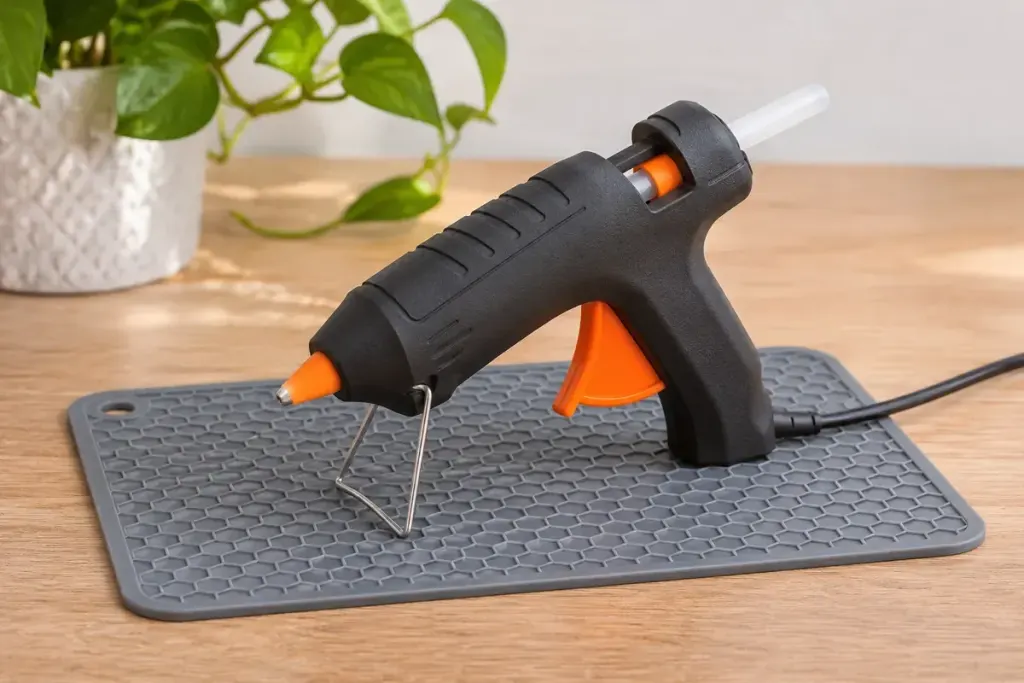
The awkward moment often comes between pieces: you have applied the glue, both hands are needed to position the material, and the hot gun suddenly has nowhere sensible to go. Solve that moment before plugging it in.
Dremel’s glue-gun guidance tells users to rest the tool on its stand when it is not being used. The manufacturer’s instructions for your own model remain the starting point, including the correct glue sticks and temperature setting.
Build a resting area, not just a clear patch
Set the gun’s stand on a stable, suitable heat-resistant surface. Keep the nozzle and likely drips away from paper scraps, fabric, cable insulation and the edge of the table. A loose sheet that can slide with the gun is not the same thing as a secure work surface.
Before heating, move your hands through the task once. Can you return the gun to its stand without crossing another person’s reach? Will its cable catch a chair, pull across the glue or tempt a child to tug it? Reposition the work while everything is still cold.
Keep the stand in use during short pauses. Laying the gun on its side can put the hot nozzle against materials it was never meant to heat. A silicone nozzle cover, where fitted, does not make the whole tool safe to grab.
Cooling is part of clearing up
Switch off and unplug as instructed when the job is finished. Leave the gun in its safe resting position until it has cooled; unplugged does not mean instantly cold. Avoid forcing a partly used stick out of a hot gun or improvising a way to clear its nozzle.
If the tool, cord or stand is damaged, stop using it and follow the maker’s repair or replacement advice. Do not continue merely because glue still comes out.
For a shared craft session, tell everyone where hot tools are allowed to rest and who is supervising them. A predictable place to put the gun makes the whole table easier to use, especially when attention shifts from the tool to a delicate assembly.