
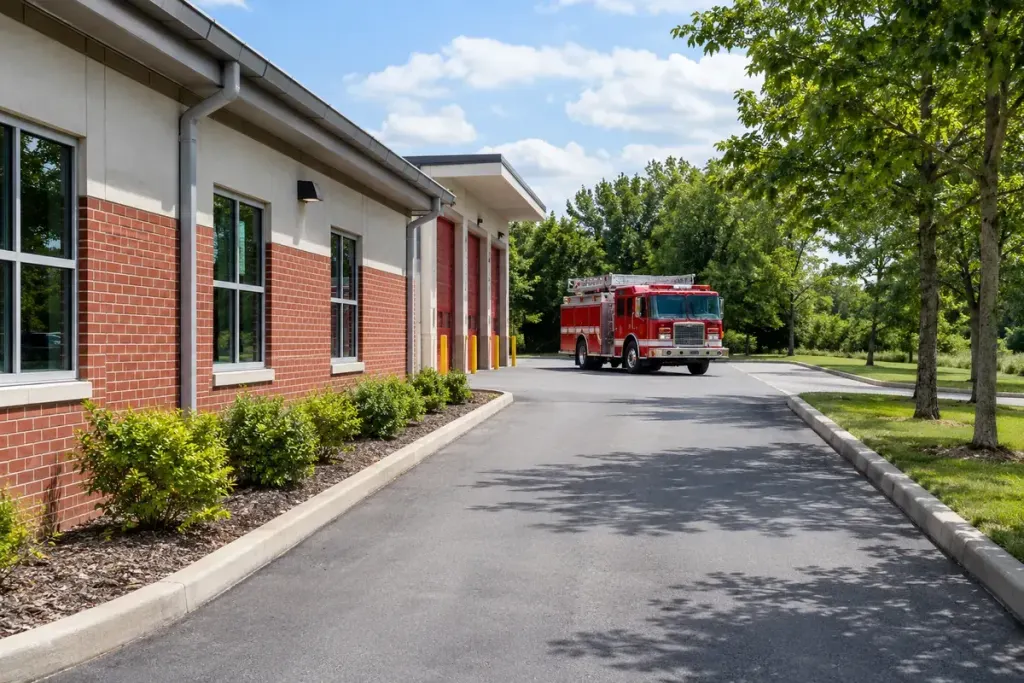
A delivery vehicle stops beside the entrance for a few minutes. A skip stays for the renovation. A planter gradually becomes part of the driveway. Each change may seem ordinary until the space is needed by a fire engine.
The UK government’s fire-risk guidance for offices and shops says that provided fire-service access roads, standing areas and access facilities must be maintained and available when required. Where several occupiers share a building, cooperation is part of keeping those facilities usable.
Walk the whole route with the responsible person
Begin where an emergency vehicle would approach the property, rather than at the front door alone. Identify the designated access route, gates, turning areas and places reserved for equipment. Use the site’s assessed arrangements and local fire-service requirements; a general width quoted online is not a substitute for the building’s actual access design.
Look for temporary changes as well as permanent ones. Deliveries, event furniture, parked motorcycles, waste containers and construction materials can alter a route that was clear during the last inspection. A gate may appear accessible while its operating arrangement is unfamiliar to the people on duty.
- Make the required clear areas understandable to staff and contractors.
- Give deliveries and waste collections a place that respects the emergency route.
- Include access checks when planning maintenance work or a temporary event.
- Report an obstruction through the building’s established process and confirm it has been resolved.
Keep firefighting access distinct from occupants’ escape routes. Both matter, but clearing one does not prove the other is adequate. Do not move emergency equipment or change gates and barriers without the responsible person’s assessment.
If an emergency is already under way, follow the evacuation plan and emergency-service instructions. Do not delay leaving to reorganise parked vehicles. The point of an ordinary-day access check is to remove that problem while there is time to solve it calmly.