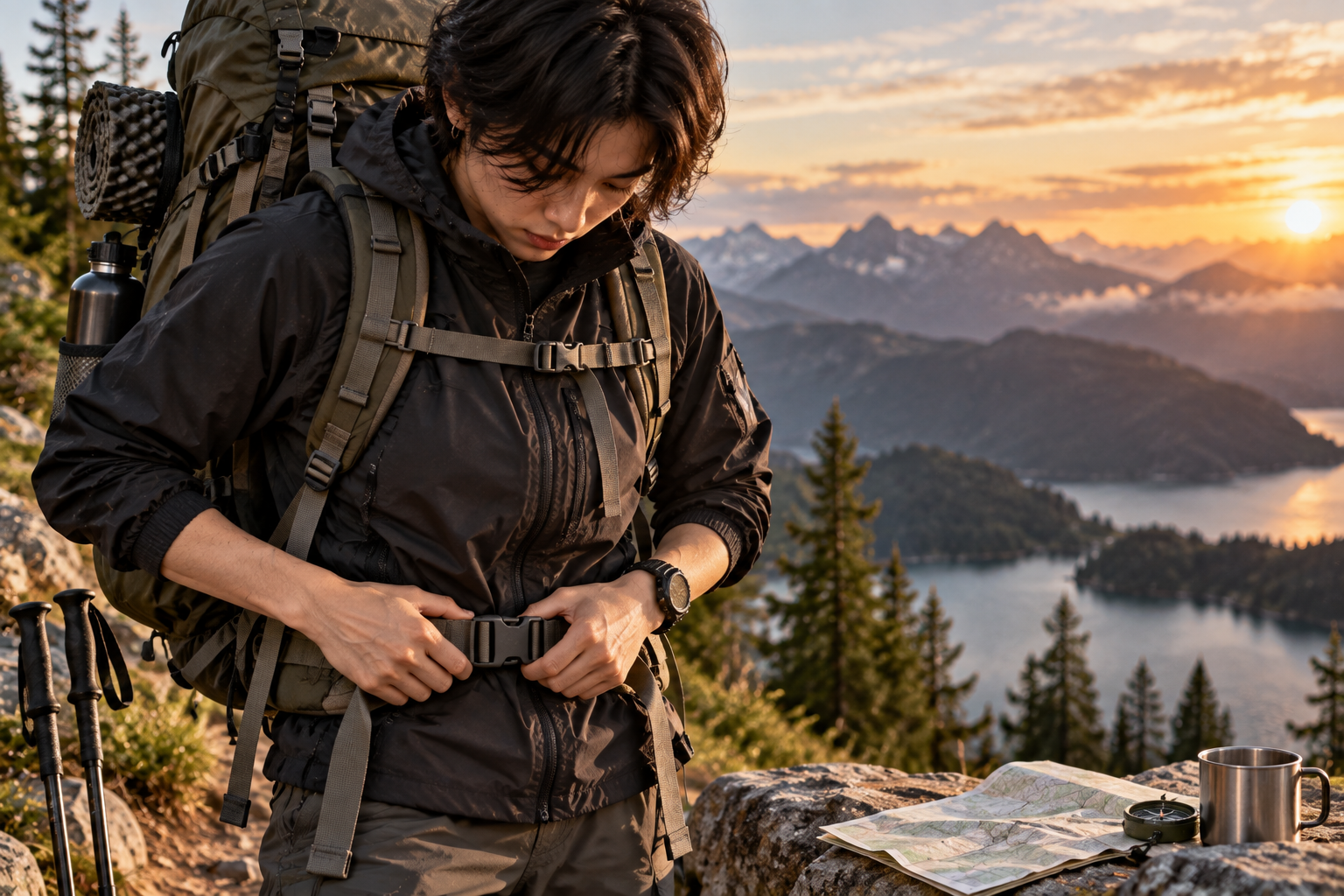
At the trailhead, everything seems fine.
Your backpack is packed, the shoulder straps feel secure, and the weight does not seem particularly intimidating. You walk the first kilometer without thinking about it.
Two hours later, the same pack feels completely different. Your shoulders ache, the straps seem to dig deeper with every step, and you keep leaning forward as though the backpack is trying to pull you backward.
The problem is not always that your backpack is simply “too heavy.” Learning how to adjust a hiking backpack means understanding how the pack fits your body and where its weight is actually being carried.
A Hiking Backpack Should Not Hang Entirely From Your Shoulders
Shoulder straps are important, but they are not supposed to behave like the handles of a shopping bag.
On a properly fitted hiking backpack with a supportive hip belt, a significant portion of the load should be transferred toward the hips rather than hanging entirely from the shoulders.
That matters because carrying concentrated pressure on the shoulders for several hours can become uncomfortable even when the total pack weight initially seems manageable.
If your shoulders begin hurting unusually early, look at the entire fit before assuming the solution is simply tightening the shoulder straps harder.
Start With the Correct Torso Length
Backpack size is not determined only by your height.
Two hikers of similar height can have different torso lengths, which changes how a backpack sits between the shoulders and hips.
Many hiking packs are sold in different torso sizes or include adjustable suspension systems. If the torso setting is substantially wrong, the hip belt and shoulder straps may struggle to sit where they were designed to.
A pack that is too long can place the hip belt incorrectly. One that is too short may prevent the shoulder harness from wrapping naturally around the upper body.
Before fine-tuning straps, make sure the basic pack size is appropriate.
Position the Hip Belt First
When adjusting a loaded backpack, the hip belt is one of the best places to begin.
It should sit around the hip area rather than hanging loosely below it or riding excessively high around the waist. Exact positioning varies somewhat with body shape and backpack design, but the belt needs solid contact to transfer weight effectively.
Fasten it securely without making it painfully tight.
When positioned correctly, the pack should already feel more supported before the shoulder straps are fully adjusted.
If loosening your shoulder straps immediately causes the entire backpack to collapse downward, the hip belt may not be carrying much of the load.
Then Adjust the Shoulder Straps
Once the hip belt is supporting the pack, tighten the shoulder straps until they follow the shape of your shoulders comfortably.
They should help keep the backpack close to your body.
They should not need to be pulled so aggressively that all the pack’s weight returns to your shoulders.
This is a common mistake when a backpack feels unstable. The hiker keeps tightening the shoulder straps because the pack feels more secure for a moment.
Unfortunately, stability gained by crushing the shoulders is not a good long-distance solution.
The goal is close contact without excessive pressure.
Load Lifters Help Control the Top of the Pack
Many larger hiking backpacks include small straps running from the upper shoulder area toward the top of the pack.
These are commonly called load lifters.
Their job is not to lift the entire backpack off your body. Instead, they help influence how the upper section of the pack sits relative to your shoulders.
If they are extremely loose, the top of a loaded backpack may lean away from your body.
Pull them excessively tight and you can distort the shoulder harness.
Use them as a fine adjustment after the hip belt and shoulder straps are already reasonably positioned.
The Sternum Strap Is for Stability, Not Maximum Tightness
The small strap connecting the two shoulder straps across your chest can help stabilize the harness.
This is especially useful when walking over uneven terrain.
But tighter is not automatically better.
Cranking the sternum strap inward can make the shoulder straps sit awkwardly and may feel restrictive.
Adjust it until the shoulder straps remain comfortably positioned without pulling everything unnaturally toward the center of your chest.
Think of it as a stabilizer rather than a clamp.
Packing Can Ruin an Otherwise Good Fit
You can adjust every strap correctly and still end up with an uncomfortable backpack if the contents are badly distributed.
Imagine placing several dense items at the very back of the pack, far away from your spine.
That weight creates leverage.
Instead of simply carrying the mass vertically, your body now has to counter the pack pulling backward.
The natural response is often to lean forward.
After several hours, that posture can make the backpack feel much more exhausting than its actual weight suggests.
Keep Dense Items Relatively Close to Your Body
For typical trail hiking, heavier compact items are generally easier to manage when positioned reasonably close to your back rather than hanging far away from it.
The exact packing arrangement depends on the backpack, terrain, and equipment, but keeping the center of mass controlled usually improves stability.
Think about a bottle of water.
Holding it against your chest is easy.
Hold the same bottle at arm’s length and your muscles work much harder even though the bottle has not gained any weight.
A poorly packed backpack can create a similar mechanical disadvantage.
Do Not Put Every Heavy Item at the Bottom
It is tempting to pack according to one simple rule: heavy things go at the bottom.
That is not always ideal.
If too much dense weight sits extremely low, the backpack can feel as though it is dragging downward. If heavy equipment is positioned too high, the pack may become top-heavy and unstable.
Aim for balanced distribution appropriate to the activity.
Light, bulky equipment often works well in areas where easy access or structural support matters less, while denser items should be positioned with the pack’s center of gravity in mind.
Stop Carrying Things You Never Use
Backpack comfort begins before strap adjustment.
Lay everything out before a hike and ask why each item is coming.
Safety essentials should not be removed merely to chase an impressively low pack weight. But many hikers gradually accumulate duplicate or unnecessary items without noticing.
An oversized power bank, multiple heavy containers, excessive spare clothing, bulky packaging, and equipment brought “just in case” can quietly add significant weight.
One unnecessary item may not matter.
Ten unnecessary items can.
Water Weight Adds Up Quickly
Water deserves special attention because it is both essential and heavy.
One liter of water weighs roughly one kilogram before considering the container.
That means your water strategy can significantly change backpack weight.
The solution is not to carry dangerously little water. Instead, plan according to the route, weather, available water sources, treatment options, and your individual needs.
A trail with reliable refill opportunities creates a different packing problem from a dry route with no dependable water access.
Route planning and pack weight are connected.
Food Can Become Surprisingly Heavy Too
A long hike requires adequate food, but not every food provides the same amount of useful energy for its weight and volume.
Large containers and excessive packaging can also take up unnecessary space.
For longer trips, hikers often think carefully about foods that are practical to carry, easy to eat, and suitable for the conditions.
Again, this is not about packing the smallest possible amount.
It is about making deliberate choices instead of throwing random kitchen items into the backpack the morning of the hike.
Keep Frequently Used Items Accessible
Comfort is not only about weight.
It is also about avoiding repeated unpacking.
If sunscreen, snacks, rain protection, water, or another frequently needed item is buried beneath everything else, every stop becomes a small logistical operation.
That encourages hikers to attach random items externally or repack carelessly during the day.
Use accessible pockets and compartments intentionally.
A well-organized pack is easier to keep balanced because equipment tends to return to its proper location.
External Gear Can Change the Balance
Strapping equipment to the outside of a backpack is sometimes necessary, but placement matters.
A heavy object swinging from one side can affect balance.
Bulky items attached far behind the pack can pull the center of gravity backward. Loose equipment can also move with every step, making the load feel less stable.
Secure external items firmly.
Whenever possible, distribute them so the backpack does not become dramatically heavier on one side.
A pack should move with you rather than constantly shifting against you.
Adjust the Pack After You Start Walking
A backpack that feels good while standing beside the car may feel different after thirty minutes.
Your clothing settles.
The load shifts slightly.
Your body warms up.
This is normal.
Stop occasionally and make small adjustments. You may want to loosen the shoulder straps slightly, reposition the hip belt, or modify the load lifters.
Tiny changes can noticeably alter where pressure is concentrated.
There is no prize for keeping every strap in exactly the same position for an entire hike.
Changing Pressure Can Improve Comfort
Even with a well-fitted pack, carrying weight for hours can become tiring.
Some hikers make small strap adjustments during the day to change pressure points.
For example, they may briefly allow the shoulders to carry slightly more load before shifting emphasis back toward the hips.
The objective is not to constantly rebuild the entire fit.
It is simply to avoid leaving exactly the same areas under identical pressure for many hours when minor adjustments can provide relief.
Watch What Your Posture Is Telling You
Your body often reveals backpack problems before you consciously identify them.
If you are constantly leaning far forward, the pack may be pulling backward.
If one shoulder repeatedly feels more loaded, the contents may be unevenly distributed or the harness may need adjustment.
If the pack sways dramatically from side to side, it may be too loose or poorly packed.
If the hip belt keeps sliding, check its position, fit, and overall load.
Do not ignore these clues until discomfort becomes severe.
More Padding Does Not Automatically Fix Bad Fit
A backpack with thick shoulder padding can feel luxurious in a store.
But padding cannot compensate for fundamentally poor load distribution.
Even a heavily cushioned strap can become uncomfortable if it carries too much weight for several hours.
Likewise, an expensive backpack is not automatically comfortable if its torso length or hip belt does not fit your body.
Suspension design matters.
Fit matters.
Packing matters.
All three work together.
Your Backpack Should Match the Trip
A short day hike and a multi-day trip do not necessarily require the same backpack.
Carrying a large expedition pack for a short trail can encourage unnecessary packing. Using a tiny daypack for equipment that exceeds its intended capacity can create another set of problems.
Choose pack volume and suspension according to what you genuinely need to carry.
The more weight involved, the more important a supportive carrying system becomes.
A backpack is not just storage.
It is equipment designed to transfer a load to a moving human body.
Test the Pack With Real Weight Before the Trip
Trying on an empty backpack tells you very little.
Almost any backpack can feel comfortable when it contains nothing.
Before a significant hike, load the pack with approximately the equipment and weight you expect to carry.
Then walk with it.
Use stairs, walk around the neighborhood, or take it on a shorter trail.
Pay attention to pressure on your shoulders, hips, lower back, and chest.
Finding a fit problem near home is much easier than discovering it several kilometers from the trailhead.
Pain Should Not Be Treated as Normal Backpacking
Some muscular fatigue can be expected when carrying a load, especially if you are not accustomed to it.
Sharp pain, numbness, severe chafing, or persistent discomfort is different.
Do not assume suffering is simply part of hiking.
Stop and inspect the pack.
Check whether a strap is twisted, a hard object is pressing through the back panel, the load has shifted, or the hip belt has moved.
If significant symptoms persist despite adjustments, continuing to force the issue may make the situation worse.
Learn the Backpack Before You Need It
Modern hiking packs can have a surprising number of straps.
Waiting until you are exhausted on the trail to figure out what each one does is not ideal.
At home, identify the hip belt, shoulder adjustment, sternum strap, load lifters, compression straps, and any torso adjustment system your backpack includes.
Load it.
Change one adjustment at a time and notice what happens.
Understanding those controls makes troubleshooting much easier once you are actually hiking.
Conclusion
Learning how to adjust a hiking backpack is not about pulling every strap as tight as possible.
Start with a pack that matches your torso and trip. Position the hip belt so it can carry a meaningful portion of the load, then use the shoulder straps, load lifters, and sternum strap to stabilize the backpack without concentrating all the pressure on your upper body.
Packing matters just as much as adjustment.
Keep dense items reasonably close to your body, distribute weight carefully, secure external equipment, and question unnecessary gear before it reaches the trail.
Most importantly, test the backpack under realistic weight.
A pack that feels comfortable for thirty seconds in front of a mirror has not proven much.
The real test is whether it still works with your body after the trail has been climbing for two hours—and you have stopped thinking about the backpack entirely.