
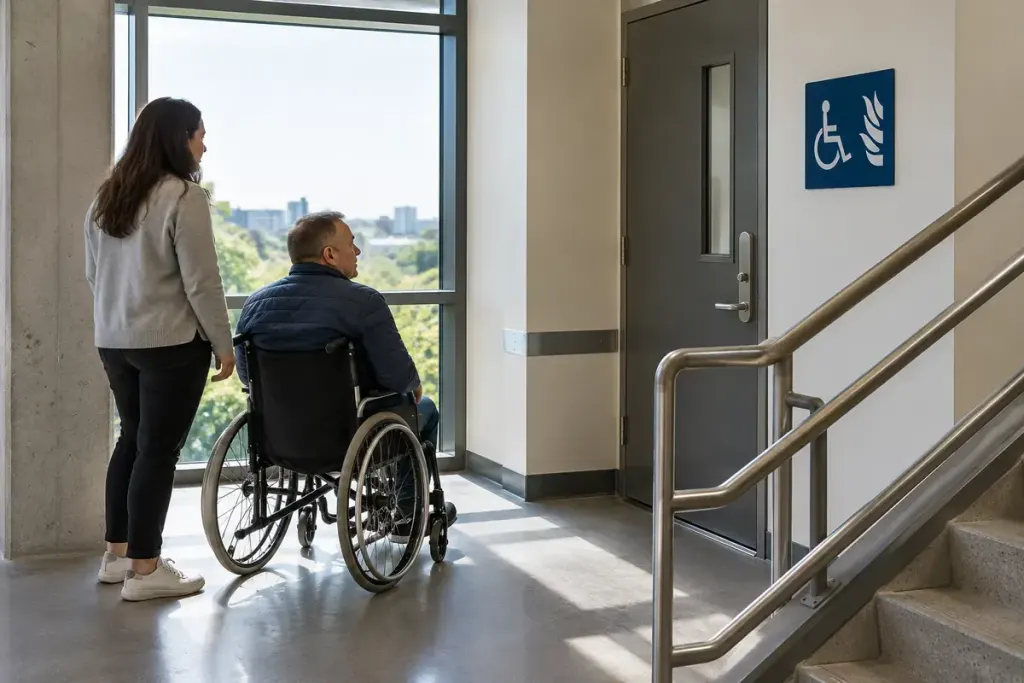
A sign marking an evacuation refuge can be misunderstood as an instruction to wait indefinitely. A refuge is a planned part of an evacuation arrangement. Its usefulness depends on what happens next and who knows that assistance is needed.
The UK government’s fire-safety guidance for offices and shops describes refuges as places of reasonable safety linked to effective management arrangements. It says the strategy should not depend on firefighters rescuing people left there. Requirements differ between buildings and jurisdictions.
Ask about the whole route
Before an emergency, ask the responsible building staff how the refuge fits your evacuation needs. Establish the suitable route, the communication method, who will respond and how the onward evacuation is organised. A floor-plan symbol alone does not answer these questions.
For example, a visitor attending a workshop may need to know which member of staff will meet them and how a change of room affects the arrangement. That conversation should happen during ordinary planning, with the person’s own input.
Do not assume every lift, stair landing or enclosed lobby is a designated refuge. Follow the building’s assessed procedures and trained staff instructions. Never wedge fire doors open or store equipment in a protected area to make it more convenient.
Practise the communication, not an improvised rescue
Ask staff to explain or demonstrate the designated communication equipment under normal conditions. Clarify the fallback if the expected contact cannot be reached. Any assisted movement or specialist evacuation equipment requires the building’s appropriate plan and trained personnel.
If you manage an event, confirm these arrangements with the venue rather than copying a sentence into a booking form. An effective plan connects a real person, a usable route and a responsible response. It should not leave the person having to invent the next step during an alarm.