
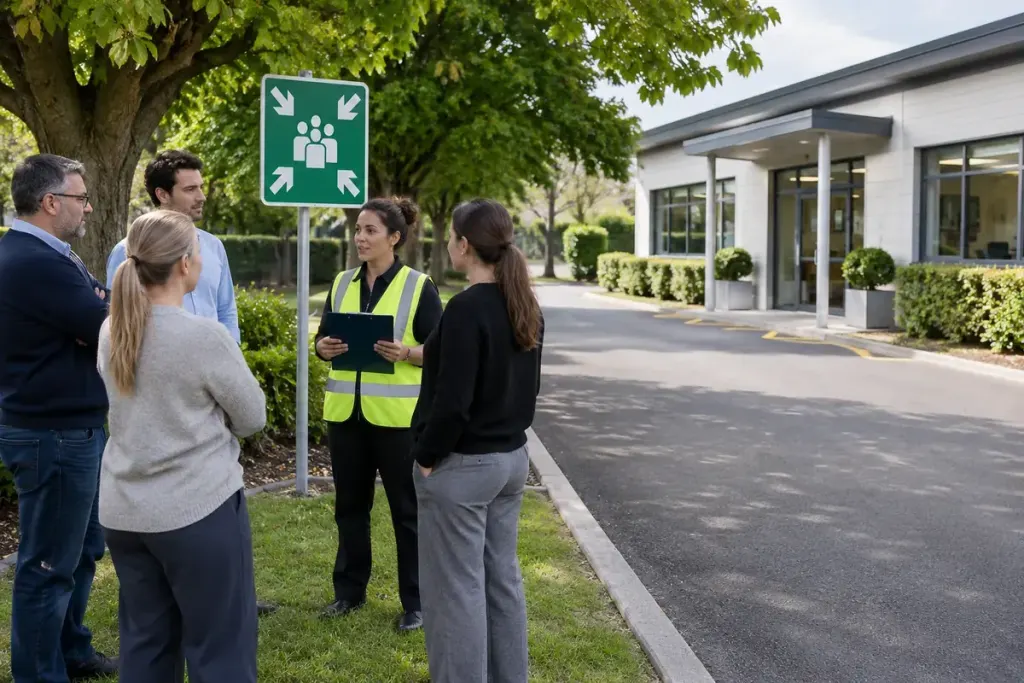
Everyone has left the building, but the group is standing in the driveway where the fire crew needs to arrive. An evacuation meeting point has to solve more than the problem of keeping people together. Its location must also support the emergency response.
The British Fire Consortium’s assembly-point guidance emphasises a designated location away from the building and clear of vehicle access routes. This is a planning principle; the suitable distance and location depend on the building, its hazards and the applicable fire-safety requirements.
Walk the route before there is an emergency
Ask the person responsible for the fire plan to consider the whole journey. Can occupants reach the point without crossing a busy road, negotiating locked gates or moving into a delivery route? Can people using mobility aids reach and wait there? Does a crowd spill back into an exit when the usual attendance is doubled?
Think of a small office sharing a courtyard with a workshop. The attractive open space beside the gate may also be the only route for a fire appliance. “Outside” and “out of the way” are not the same location.
Make the point usable for accountability
Staff, visitors and contractors need a clear instruction, including who will account for them and how information about a missing person reaches responders. A landmark should be unambiguous: “the marked assembly area beside the far boundary” is easier to follow than “somewhere near the car park”.
Consider how the plan handles smoke, construction work or another hazard making the normal point unusable. Alternative arrangements should be agreed in advance and communicated, rather than invented by several people at once during an evacuation.
Use a drill to find the awkward details
Observe congestion, access and communication during a planned drill, then record the changes needed. Do not move an official assembly point casually without updating the responsible person’s plan and signs. During a real incident, follow the building’s emergency instructions and responders’ directions. Nobody should re-enter to search for someone or collect belongings; pass the information to the emergency service instead.