
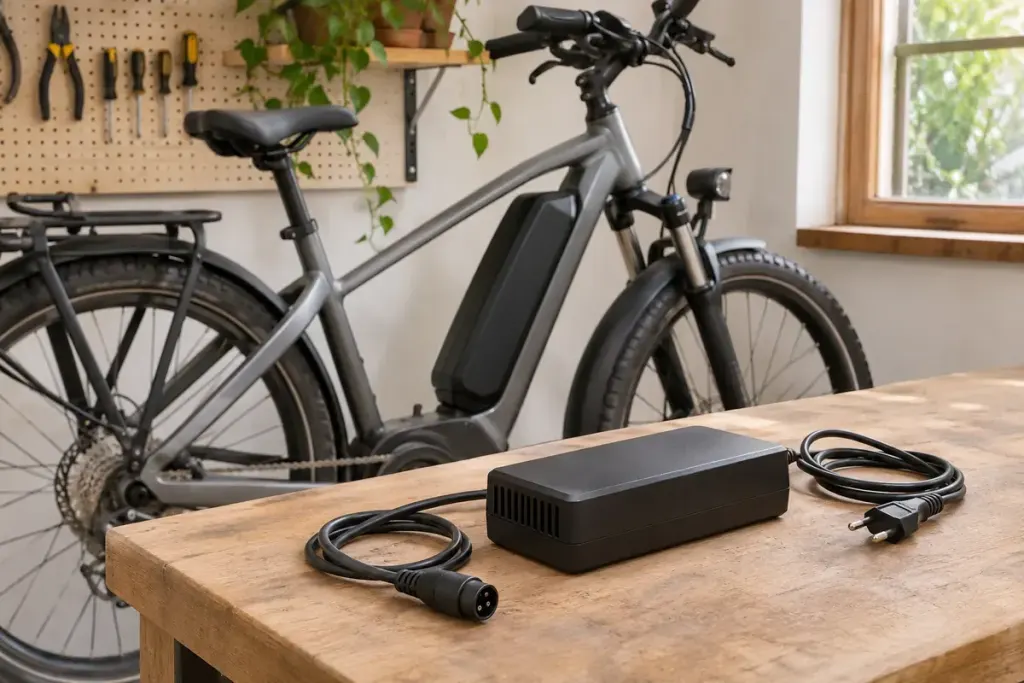
The old charger has failed, and a replacement listing shows a connector that looks identical. That visual match is only the start of the question. An e-bike battery needs a charger approved for its particular system; a plug fitting into the socket does not establish electrical compatibility or safe charging control.
The National Bicycle Dealers Association’s charging guidance directs shops to use the charger supplied by the e-bike manufacturer. For a replacement, obtain the manufacturer’s current approved part or written compatibility advice for the exact battery model.
Collect the identifiers before ordering
- Photograph the bicycle, battery and original charger model labels.
- Keep the serial or product reference with the request to the manufacturer or authorised dealer.
- Ask whether the proposed charger is approved for that battery, including any model-year differences.
- Keep the reply and purchase details with the bicycle’s documents.
Do not describe the system only by battery capacity or nominal voltage. Those numbers do not communicate every relevant design detail. Likewise, a marketplace phrase such as “universal” is not the same as a manufacturer confirming a specific pairing. Avoid improvised adapters or altered connectors.
Compatibility does not replace a charging routine
Follow the battery and charger’s instructions for location, temperature, supervision and disconnection. Keep charging equipment away from escape routes and combustible clutter. If a battery or charger is damaged, swollen, unusually hot or behaving abnormally, stop using it and obtain appropriate professional advice. Do not keep trying another charger as a diagnostic experiment.
For a shared household, make the approved charger easy to identify without covering its ventilation openings or technical label. Store the instructions where the next person charging the bike can find them. A clear equipment match and a clear routine work together; neither can be replaced by a connector that happens to fit.