
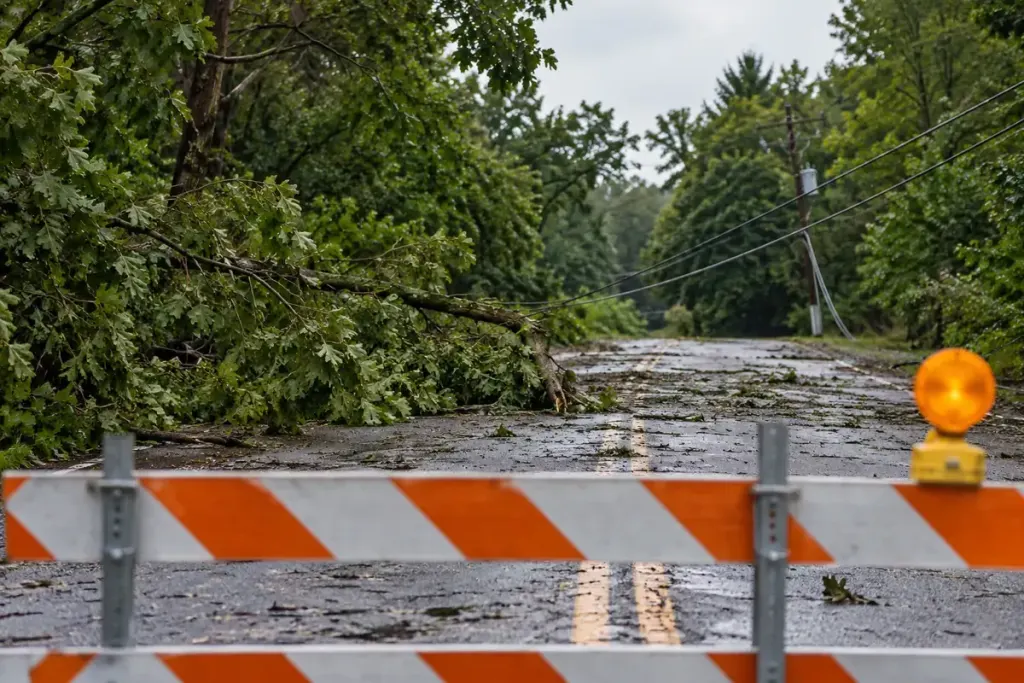
A cable lies across a fallen branch after a storm. There are no sparks, no noise and no obvious movement. None of those observations establishes that it is safe to approach.
Stay well away from fallen power lines and anything they may be touching, including water, fencing, vehicles and branches. Keep other people and animals away without placing yourself closer to the hazard. Follow local utility and emergency-service instructions for the situation.
Your first job is distance, not identification
Do not lift the wire with a tool, move the branch, test it or walk closer for a better photograph. You cannot reliably identify an electrical hazard from its appearance. The CDC’s electrical-hazard guidance advises avoiding downed lines and not driving through standing water containing them.
From a safe location, contact the electricity utility or emergency services as appropriate. Give the street, nearest useful landmark and what the line appears to cross. Report people or traffic at immediate risk. A precise location is more useful than an ambitious close-up.
Change the route
If the hazard blocks your usual walking or driving route, use an alternative and respect barriers. Do not follow another person through because they appeared to get past safely. Conditions can change, and their action does not verify the route.
Tell household members about the affected location through a clear message. Avoid forwarding an unverified claim that the power has been disconnected. Only the responsible utility or emergency personnel can establish when the area is safe.
For planning before storms, save the correct utility fault-reporting details where you can find them offline. Check that everyone knows the difference between reporting a damaged street asset and responding to an immediate emergency.
If a line contacts a vehicle, the response has additional risks; follow emergency-service instructions and do not improvise an exit or approach someone else’s vehicle. The general lesson remains simple: the absence of visible activity is not a safety test. Leave assessment and removal to the people equipped to do it.