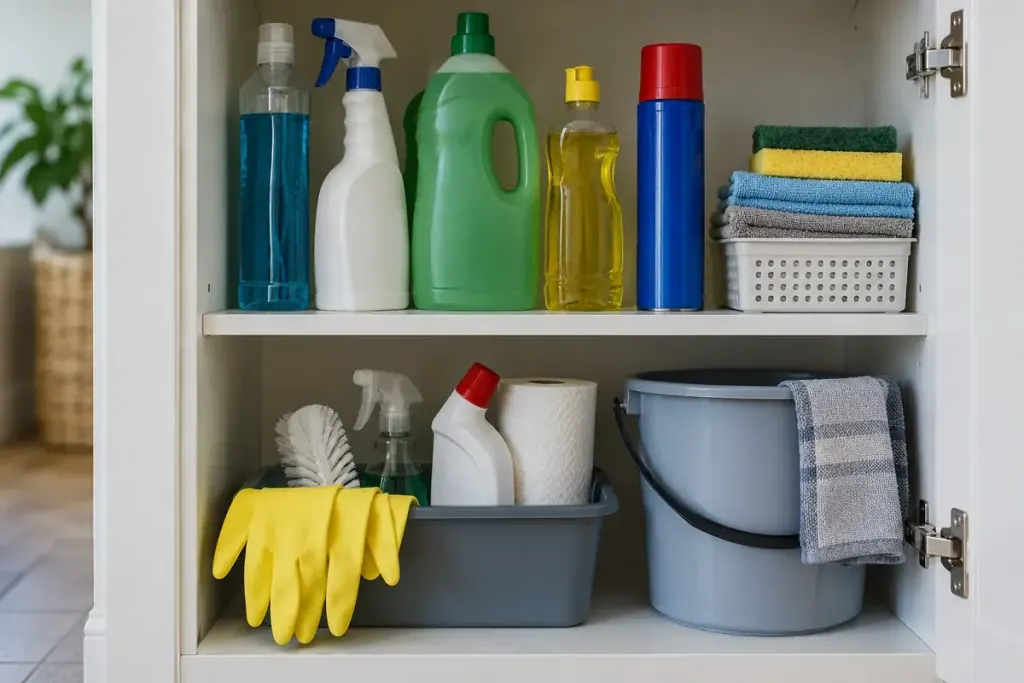
An unlabelled bottle beneath the sink creates a problem before anyone opens it. Is it a cleaner, a solvent or something left by a previous occupant? Guessing by colour or smell is not a safe way to identify the contents.
The US Environmental Protection Agency’s household hazardous-waste guidance advises keeping hazardous products in their original containers with labels intact, never in food containers. It also warns against mixing leftovers and recommends local guidance for damaged containers and disposal.
The label is part of the equipment
Storage directions, precautions and emergency information can be lost when a product is decanted into a convenient bottle. A handwritten name alone may not preserve the information needed by another household member.
Buy a size you can manage and store according to the label. Do not combine partly used containers to make space unless the manufacturer explicitly provides a safe procedure. Similar colours or product names do not establish compatibility.
Handle uncertainty without experimenting
If a container is unlabelled, leaking or corroded, keep people and pets away and seek instructions from the appropriate local hazardous-materials or waste service. Describe what you know without opening, sniffing or mixing it to investigate.
Do not pour an unknown product down a drain or place it in ordinary rubbish simply to remove it from the house. Ask how it should be handled and whether the collection service needs advance notice.
For known products, keep storage inaccessible to children and follow the packaging’s closure instructions. An attractive storage container is not an improvement if it removes the original safety information or makes the product resemble something drinkable.
A useful cupboard check is modest: intact packaging, readable labels, suitable storage and a clear plan for unwanted products. The aim is to prevent the next person from having to guess what is in a bottle at the exact moment they need reliable information.