
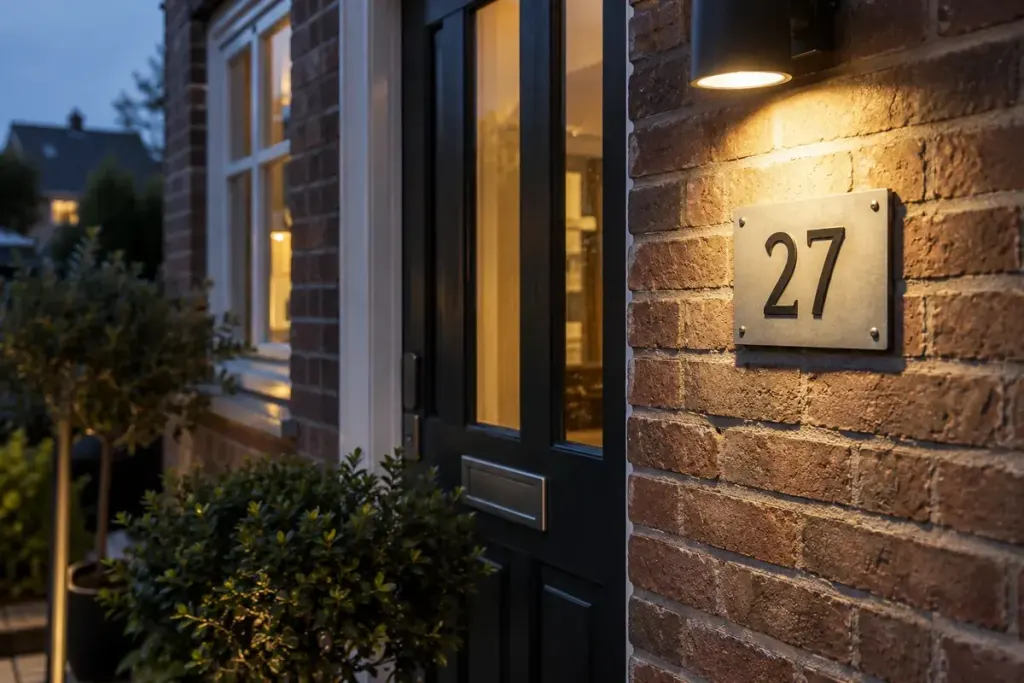
You know exactly which house is yours. Someone approaching at night in an unfamiliar street may have only an address and a few seconds to identify the entrance. A number hidden behind foliage or visible only from one direction adds uncertainty at the wrong time.
Address visibility is a small preparedness task that can be checked without touching emergency equipment or changing the building’s systems.
Look from the ordinary approach
From a safe public position, assess whether the number can be read from the route a visitor would normally use. Check in daylight and after dark. Do not stand in traffic or create a hazard to test the view.
Consider vegetation, parked vehicles, a gate left open and decorations that may cover the sign. For buildings with several entrances, ask whether the official address and unit identification guide someone to the correct place.
A close-up photograph of a plaque proves it exists, not that it can be located from the street. The more useful question is whether an unfamiliar person could find it without already knowing where to look.
Use the local requirements
Check guidance from the local fire service, municipality or building manager before choosing size, placement or lighting. Requirements differ; a decorative number that suits one property may not meet the rules for another.
Tenants and residents of shared buildings should report obscured or missing identification through the responsible manager. Do not alter shared electrical lighting or install signs where permission is required without following that process.
Include the details in an emergency call
Know the complete address and any information needed to distinguish the entrance or unit. Follow the call handler’s instructions and do not leave a safe location or delay evacuation just to meet responders.
A fictional household check might reveal that the number is clear from the pavement but hidden when the gate swings open. Photographing that condition and arranging a permitted correction is a specific improvement.
Recheck after gardening, repainting or installing a new gate. A readable address does not replace smoke alarms, escape planning or an emergency call, but it removes one avoidable obstacle to finding the right door.
The US Fire Administration illustrates the importance of a visible address. Confirm any local requirements with the responsible service rather than copying an arbitrary number size.