
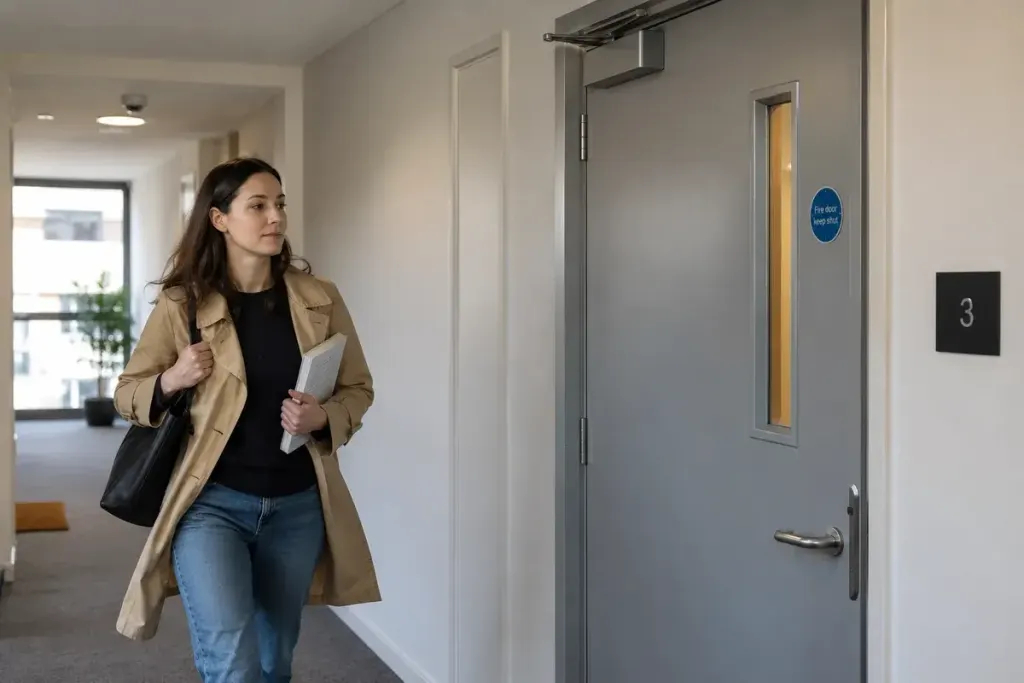
The door bangs, so someone wedges it open. The corridor becomes quieter and carrying shopping feels easier. But a door intended to resist the spread of fire and smoke cannot do its job across an opening that remains unprotected.
Fire-door safety is partly about ordinary habits. It also depends on the correct door assembly, installation and maintenance. A resident’s observation can identify a concern; it cannot certify that a door is compliant.
Know which door you are looking at
Ask the building manager or responsible person which doors have a fire-safety role and how concerns should be reported. Do not assume that every heavy door is a fire door, or that a painted label proves the whole assembly is suitable.
London Fire Brigade’s advice for the home explains why fire doors and their closing arrangements matter. Follow the fire strategy and instructions for your own building, including its evacuation arrangements; advice for one type of property may not describe another.
Look for changes in everyday use
Notice a door that no longer closes properly, catches on new flooring, has visibly damaged components or has a closer that appears disconnected. Also notice objects obstructing its movement. Report what you can observe rather than attempting to name the technical fault.
A useful report identifies the exact location, when the problem was noticed and what happens during normal use. For example: “The second-floor lobby door remains partly open after people pass through.” A photograph may help if taking it is safe and permitted.
Do not solve the nuisance by defeating the protection
Avoid wedges, improvised hooks and unapproved alterations. Do not adjust a closer, trim the door or replace seals yourself unless you are the competent person authorised for that work. Approved hold-open systems have specific functions; they are not equivalent to a household object under the leaf.
If the door is difficult for someone to use, raise that access problem too. The answer should address both accessibility and fire protection through the appropriate responsible people, rather than leaving residents to choose between them.
Follow the report through
Keep the reference or acknowledgement and use the building’s escalation route if a defect remains unresolved. During an actual fire or immediate danger, follow emergency instructions instead of stopping to document a maintenance issue.
A functioning fire door should be an unremarkable part of daily life. Keeping it that way requires reporting small changes before they become an accepted workaround.