
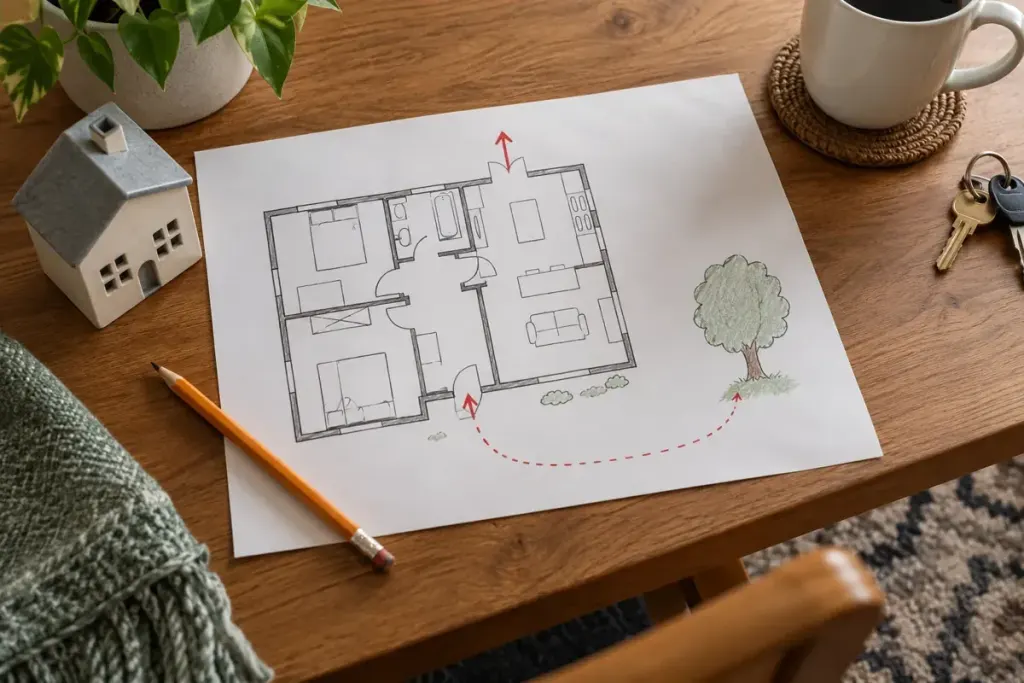
A fire escape plan needs to make sense to everyone who sleeps in the home. A diagram stored in a drawer is only the beginning. The useful work happens when people discuss the routes, notice obstacles and practise safely together.
The US Fire Administration recommends mapping doors and windows, identifying two ways out of each room, keeping exits clear and choosing an outdoor meeting place. Use its guidance alongside instructions from your local fire service and, in shared buildings, the building’s specific emergency plan.
Sketch the home as it is used
Draw rooms and exits simply; artistic accuracy is unnecessary. Include the room where a guest might sleep and the furniture that normally occupies a hallway. Discuss whether an apparent alternative route is genuinely usable. Do not improvise a climb or jump to demonstrate it.
Choose a meeting place everyone can identify safely outside, away from the building and emergency access routes. “Outside” is too vague if different people head to different sides of the property.
Ask who needs a different arrangement
Consider children, visitors and anyone whose mobility, hearing, vision or other needs affect an escape. Ask the person what assistance is needed rather than assuming. Seek help from the local fire service or building management where the plan is uncertain.
A high-rise apartment, a shared house and a detached home may require different arrangements. A generic internet drawing should never overrule the emergency instructions for a specific building.
Use a calm walkthrough to find problems
- Can people find and operate the intended exit as planned?
- Have shoes, furniture or storage narrowed the route?
- Does everyone know the chosen meeting place?
- Are assistance responsibilities understood, including when the usual helper is absent?
Practise without smoke, blindfolds, blocked routes or risky window exits. The purpose is to discover uncertainty while there is time to fix it. Stop the exercise if someone is distressed or an action would be unsafe.
Know what the plan is for
In a real fire, follow the applicable emergency instructions, get to safety and contact emergency services. Do not re-enter to collect belongings or search for someone; tell responders if a person may still be inside. Do not use a lift during a fire unless the fire service directs you to do so.
Revisit the plan after a move, room change or change in household needs. Pair it with a smoke-alarm record so the household pays attention both to warning and to the route out. A completed worksheet is useful only if the practical arrangements still work.